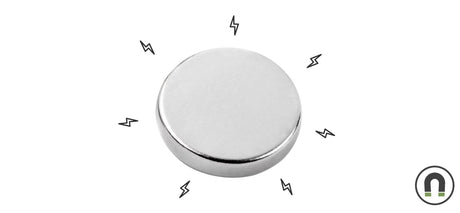
Has your magnet lost its strength? This guide is about how to remagnetise magnets that have lost some of their strength. As long as you haven't exposed your magnet to extreme heat or cold, it's actually pretty easy to make your magnet highly magnetic again.
We'll just have to go through a little theory first off, so you know whether your magnet has lost its magnetism permanently, or whether the poles have just become a little "confused" and need to be realigned again so that the magnet works optimally once more. But just so you know how simple the solution is, we'll give you the answer right away:
The solution is to use another magnet
- yes, it really is that simple!
But let's start with the temperatures that standard magnets* can withstand - their so-called max. working temperatures - to find out whether the magnetism has been lost permanently or temporarily.
Maximum working temperature
- Neodymium can withstand up to 80°C but has no lower limit.
- Ferrite withstands up to 250°C and down to -40°C
- Magnetic tape (and sheet) withstands up to 85°C and down to -20°C
*By standard magnet we simply mean that they are regular neodymium magnets with an N value and ferrite magnets with a Y value. You can get custom magnets, but they are made to be able to handle specific tasks at higher/lower temperatures, so we will not touch on them in this FAQ.
There is usually always an exception to the rule, and it is therefore important to say that the above temperatures are only indicative. The thinner a magnet is, the more fragile it is. You will experience with magnets of 1 mm. in thickness that they can start losing their magnetism already from 60°C. If, on the other hand, you have a magnet that has the same thickness as its diameter (e.g. 10x10 mm.), that magnet will often be able to withstand slightly higher temperatures (in fact up to 140°C under ideal conditions). Test this out first if you are going to use them in larger machines or similar. But we always recommend that you do not use the magnets up to the maximum limits of the working temperature for a longer period of time, as this makes the setup more fragile in relation to temperature fluctuations.
PS! No lower limit for neodymium magnets means that you can put them in liquid nitrogen without them being damaged.
No temperature effect? That's good news!
Good news if your magnet has not been exposed to higher or lower temperatures than those in the list above: then it is quite easy to remagnetise your magnet (i.e. give the magnet back its magnetism).
A weak magnet is usually caused by the magnet having received a lot of blows. For example when you put your knives on the magnetic knife rail, or when you let your toy trains with magnetic coupling collide again and again. This is something that happens to most people, but impacts can also happen in machines where the machine parts constantly collide and hit the magnets, or if you have to lift metal sheets with magnets, where the attraction itself happens at high speed.
How to remagnetize magnets
Place a magnet in your hand and point one end of the magnet in your hand towards the magnet that needs to be remagnetised. You can easily find out which end of the new magnet you need to use, as there will still be a slight attraction/repulsion from the "old" magnet, if it is not permanently damaged. You will be using the end that attracts to the old magnet.
Slowly run your hand with the magnet over the "old" magnet from one end towards the other with very little distance between the 2 magnets, and then take the magnet away and upwards when you get to the other end of the "old" magnet. Start again from the beginning by going slowly over the "confused" magnet. You should imagine drawing a horizontal D in the air in the same way with at least 10 repetitions. After that, you will experience that the magnetic poles in the "old" magnet have been realigned and that your magnet works once again. You can of course continue this until you achieve the desired effect. Just make sure to make your D-movement in the same direction every time.

Which magnets to use for remagnetisation
The magnets at the bottom of the page are good suggestions for sizes that are easy to hold and that have enough power to work from the small distance created when you go over the old magnet in a D shape.
You can use any size magnet, as long as it is at least the same width or diameter as the magnet you are trying to make magnetic again. However, we would not recommend going any smaller than these magnets, even if the magnet you need to remagnetise is much smaller. This is because it becomes almost impossible to hold a magnet smaller than 10 mm in diameter properly if you want to have full control over the magnet.
If your old magnet is larger than 10 mm, you can find many more strong magnets here.
Contact us for more information
In doubt? Please do not hesitate to contact us. We are available in customer service every weekday during opening hours (and sometimes even longer than that via email), and we have extensive experience in making magnets magnetic again. We would be happy to help you if you have any questions.